Let’s tackle a common math problem together: 8+7. It’s the type of question you find in math books all the time. And the answer is usually there in the back: 15. But what the answer guide doesn’t tell the teacher or parents is to question how your kids got 15, how did they reason about the numbers? Did they count-all or count-on? Did they double or break-apart-and-make-ten?
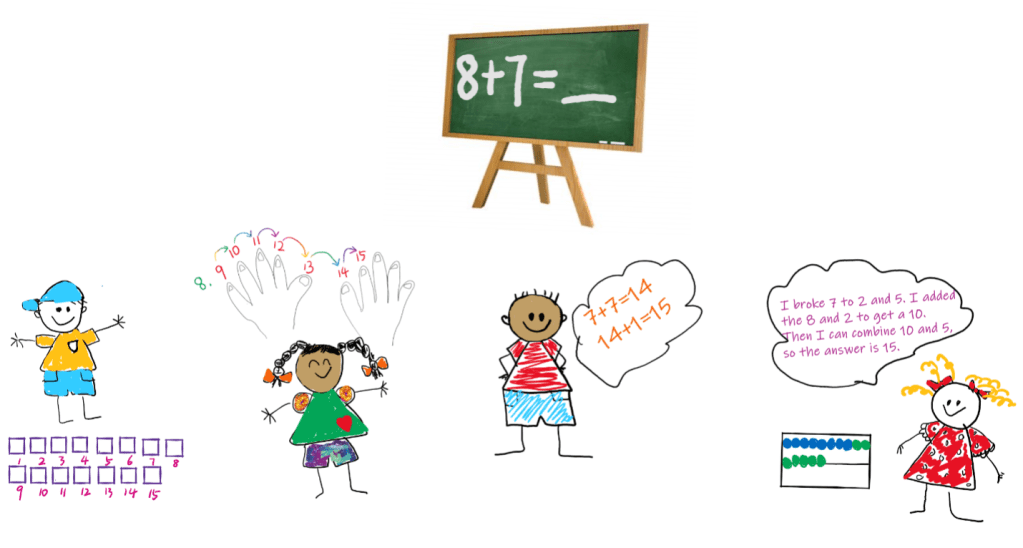
This is more than just getting an answer and explaining your work. This delves into how the students understand number on a fundamental level. Most elementary math curricula encourage students to “use different ways to solve problems.” However, little attention is given to, or even understood about, how these “different ways” highlight students’ reasoning—not about the strategies kids are taught, but rather, the understandings they have.
So, when two kids both get the answer 15, does that mean they are both at the same level of understanding? Succinctly, no.
Starting with your kids means knowing where your kids are in their reasoning based on an established developmental sequence, so that you can use the understanding they have to build where they need to go. Research (Tzur et al., 2017) has shown that when reasoning about addition, students who independently and unprompted break-apart-and-make-ten have a higher ability to develop multiplicative reasoning; with counting-all, it is virtually impossible to develop such reasoning. Even if the student can “get the right answer.”
As parents, if we know the math concepts our kids have grasped and set learning goals based on their levels of understanding, we can effectively use the tools provided by their curriculum to help them grow. This is where homeschooling can be particularly advantageous, especially if we have some professional guidance on math learning.
If you’re interested in learning more about how kids progress in math and discovering fun math activities to do at home, feel free to reach out to me at bingqian.wei@mathempowerfamily.com. Let’s explore math learning together!
 Math Empower Family
Leave a comment